When I launched my first online business, I had little knowledge about SEO most specifically the on-page SEO practices that would be foundational to my website ranking.
I searched online for on-page SEO materials and came across multiple guides but unfortunately, only a few explored the refined practices especially when it comes to their applicability to online businesses in a simplified way.
Lucky for you.
In this guide, I will save you time and also protect you from most of the common frustrations associated with on-page SEO strategies as a beginner.
You should know that; I am not refuting the authenticity and relevance of the aforementioned articles or others by industry experts.
But;
I am promising you a smooth transition with possible illustrations that will help you have a simplified and comprehensive view.
In this guide, I explore:
- Chapter One: On-Page SEO (Definition and Benefits)
- Chapter Two: Content Creation/Writing
- Chapter Three: Keywords (Research and Optimization)
- Chapter Four: Title and Description Tags
- Chapter Five: Page Speed Optimization
- Chapter Six: Internal Linking
- Chapter Seven: CTR and UX Signals
- Chapter Eight: Additional On-Page SEO Practices
Chapter One: On-Page SEO (Definition and Benefits)
Definition
On-page (also identified as on-site SEO) can be broadly defined as any SEO practice that is aimed at optimizing content on website pages for users and search engines. Some of the common on-page SEO practices comprise optimizing content, title tags, internal links, and URLs.
You should know that;
On-page SEO is aligned with 3 main goals which comprise:
- The creation of creative and user-centered content that will not only attract readability but also encourage indexing and ranking by search engines.
- Creating content that will also attract links from other websites (through the link-building process).
- Optimizing different elements of your web pages such as the site structure, code, and meta tags among many other related factors to improve user experience.
Benefits
On-site SEO improves the overall SEO of your website hence increasing your ranking on SERPs (Search Engine Result Pages) and also making it easier for you to convert your traffic.
This type of SEO also improves your site architecture hence ensuring that your content aligns with some of Google’s guidelines such as E-E-A-T (Experience, Expertise, Authoritativeness, and Trustworthiness.
It is also worth noting that Google and other search engines continue learning and improving their approach towards ranking.
This is to say that;
Gone are the days when ranking was purely based on keywords. Nowadays, you have to optimize your website for;
- User Search Intent
- Overall experience
- Web-Page Loading Speed
- Dwell Time
- Bounce Rate
- Click-Through-Rate (CTR)
Difference Between On-Page and Off-Page SEO
On-page SEO is founded on a set of optimizing elements (factors as well as techniques) that are under your control whereas in the case of Off-page SEO the associated elements are somehow out of your control and focus on increasing your domain’s authority around the web.
The most common elements of on-page SEO practices comprise;
- Content
- Keywords
- Title and Description Tags
- Links
- URL Optimization
- Structured Markup
- Image Alt-Text
- Web Page Responsiveness
- Page Speed
Chapter Two: Content Creation/ Writing
Before we begin the content creation/ writing process, I would like to briefly highlight some important factors that make up great content.
Just keep reading.
Conventionally, optimized web content is made up of target keywords, tags (title, subheading, and description), internal and external links, URLs, meta-descriptions, and structured data.
Effective application of these factors plays a major role in determining CTR (Click through rate), Bounce Rate, Indexing, Ranking, and speed of webpages.
Most importantly, your content should not only be unique but also fresh and of high quality.
Focus on generating value out of your content by considering these factors;
Unique Content
Unique content goes beyond duplicate content and includes something that is more improvised than the commonly available content information on specific topics.
As such, the content should be aligned with some new information that in many instances brings the ‘aha’ moment in your reader’s mind.
Some idea suggestions for the new thing can be:
- A discovered technique
- Uniquely picked list of curated items
- Amazing UX Design
- Case Studies
- Simplified but comprehensive processes.
Having unique content will not only improve your search engine ranking but also increase the chances of your content being placed on the fast page of Google SERPs.
Great content posts have information that can be found on many other similar sites but there are also unique factors such as graphical information that can only be found in the post hence giving it an edge.
Value-Based Content
With tons and tons of content being created every day, the primary factor that can make users stand out is the amount of value that the article delivers.
If you can remember, I highlighted the need for your content to be unique here.
However, this is never enough.
Your content should have more value by utilizing value-based selling points such as:
- Additional Details: screenshots, simplified implementation steps, and unique images.
- Unique Writing Approach: do not just write web content but adopt copywriting tricks and techniques that appeal to your target audience. In simple terms, make the content engaging.
- Incorporate the voice of industry experts: employing this strategy in your content makes it valuable and appealing to your target audience. This strategy can also include illustrations from first-hand experiences.
- Up-to-date Resource: incorporate new steps and creative examples.
Search-Intent
I explained above the importance of unique and valuable content in On-Page SEO. However, for your content to stay at the top of the SERPs you need to address and satisfy the target user search intent.
This means that you need to understand the specific intent that your content will focus on before and when creating content.
To be specific;
Target user intent should fall within these four categories:
- Informational
- Navigational
- Transactional
- Commercial
NOTE: there are instances where you can also adopt local intent especially when targeting users based on local searches and products.
A perfect example of such a case would be the illustrated case below:
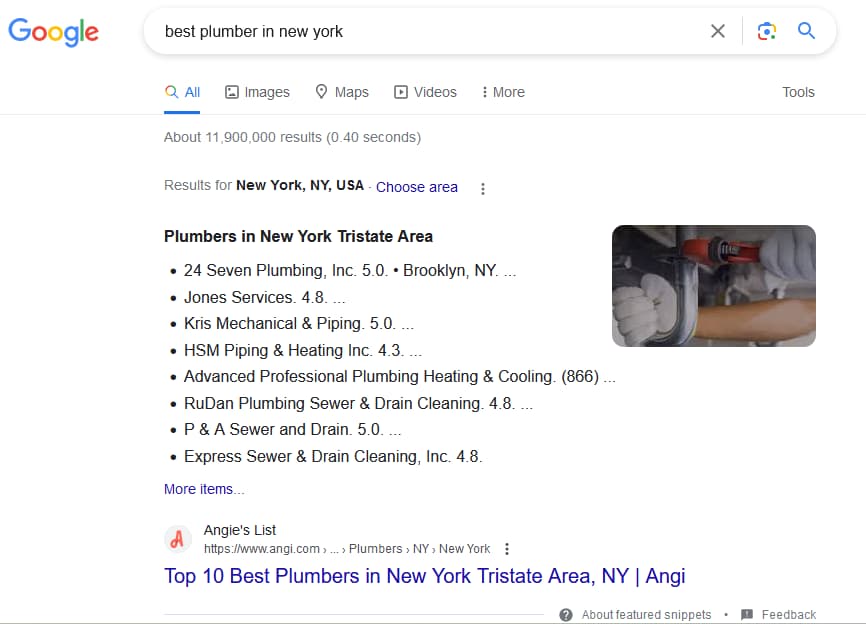
In this search, the user’s query is based on two intents which are local and informational.
As such, he/ she is trying to look for information on the best plumber while at the same time narrowing down the results to New York.
All Said and done, the best and most recommended practice when coming up with your content ideas and creating the content is to understand and adopt a specific user intent.
Chapter Three: Keywords (Research and Optimization)
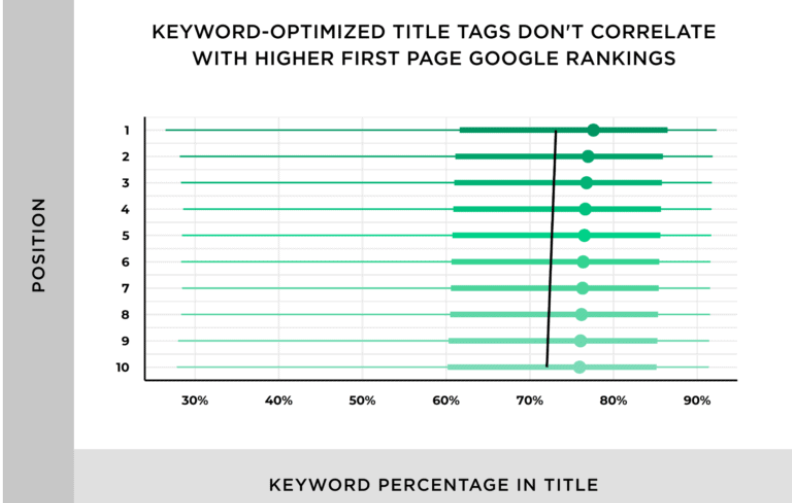
Keywords are foundational to on-page SEO practices. A study that was conducted by Backlinko in 2022 concurred with the fact that Google still indexes pages based on specific keywords.
In brief, the study incorporated search results from 11 million SERPS and the findings pinpointed a non-existing relationship between Keyword-optimized title tags and higher SERP rankings.
However, when you try to search for specific keywords such as “Yoga poses,” you will notice that the top-ranking pages use almost the same keywords in their title tags and meta-description.
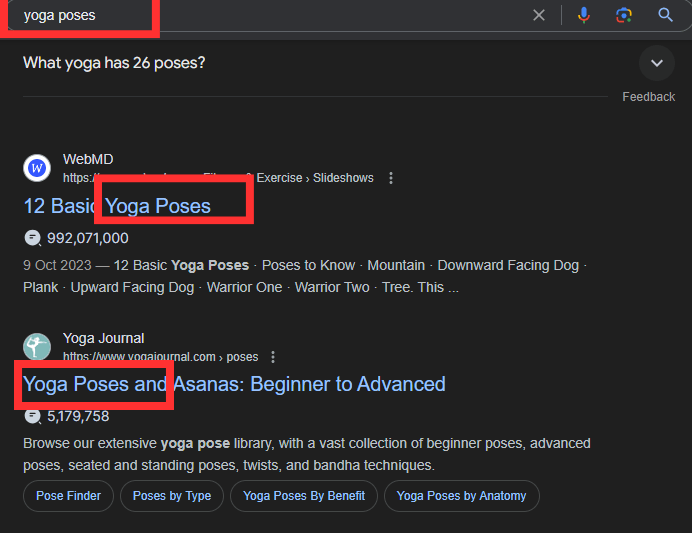
The highlighted impact of keywords especially in curating the search engine result pages pinpoint the need and importance of keyword research and optimization.
Here’s what you should know;
Keyword research is critical to any on-page SEO practice. It helps identify the specific words and potential phrases based on searches.
Keyword research can be conducted using various tools such as Google Keyword Planner, AHRefs, SEMrush, and Moz Keyword Explorer among others.
Apart from keywords, you also need to optimize your content for:
- Page Loading Speed
- Dwell Time and Bounce Rate
- Search Intent
- CTR (click-through-rate)
- User Experience
Chapter Four: Title and Description Tags
Title and description are some of the critical factors that determine Click Through Rate (CTR).
From a personal experience, optimizing the two should be listed among the top on-page SEO practices especially title tag since it makes it easier for search engines to establish the contents of your page.
Note;
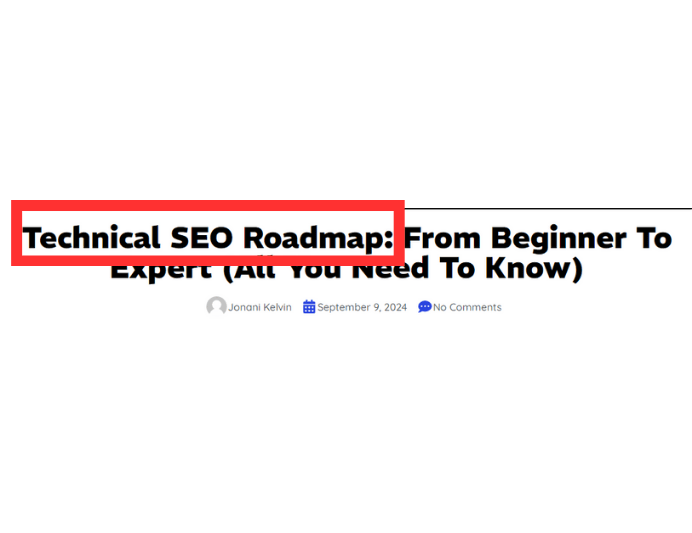
Placement of the target keyword/s on the title tag may determine its weight on search engines.
For instance,
Placing the keyword/s closer to the beginning of the title tag adds more weight in terms of its relevance to search engines.
Here’s what you should know;
Your keyword/s must not be placed at the beginning of your title unless it/they make sense at that location.
However, you should ensure that it is close to the front of your title tag.
Also;
Remember to include your keyword/s in your description tag.
Modify Your Title Tags
Depending on your title, you can improve it using modifiers such as “guide,” “definitive,” “review,” and “ultimate” among others to help you rank for long tail versions of the respective keyword/s.
Here is an example of the use of a title modifier.
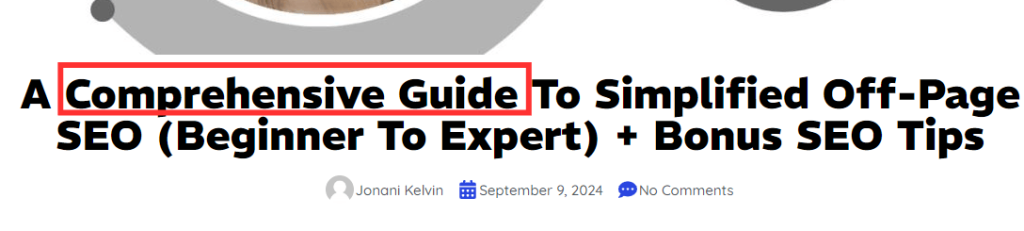
Using such an approach makes it easier for my blog post to rank even for long-tail keywords
Keyword-Rich Description Tags
Adding keyword-rich meta-descriptions to your webpages is considered a good practice by Google.
Additionally, Goggle recommends that website owners should write their meta descriptions since they have more knowledge of the specific web page contents.
But Why?
Here’s what you should know about keyword-rich meta descriptions.
They help your webpage stand out on SERP results hence boosting your organic CTR.
Meta Description Formula
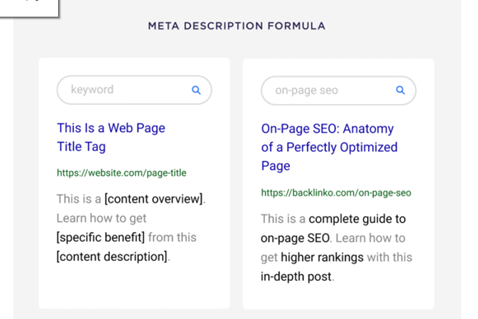
Remember to also place your keyword/s in your meta descriptions since Google highlights them in the SERPs.
Chapter Five: Page Speed Optimization

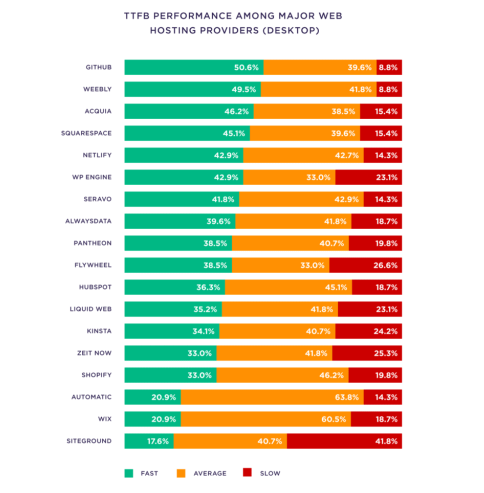
Google acknowledges that page loading speed is a key SEO ranking signal. To improve your website’s loading speed, you need to embrace some on-page SEO practices.
First and foremost, you can decide to migrate to a faster web host.
Here’s an analysis of a study that was conducted on 5.2 million websites by Backlinko on the influence of host migration on website speed.
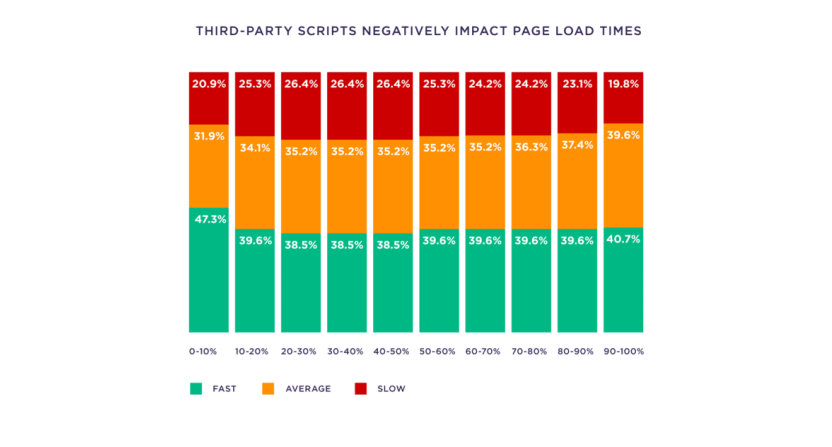
Secondly, you need to remove unused third-party scripts. Most of these scripts are known for their effect on page loading speeds.
Chapter Six: Internal Linking
Internal linking plays are critical when it comes to on-page SEO practices.
First and foremost, they help search engine robots such as Google Spiders crawl your website which will then lead to the webpages being ranked.
Secondly, they help readers navigate to other helpful pages on your website hence keeping them around for longer periods (Dwell Time). Needless to say, this process reduces your website visitor’s bounce rate.
To Google such indicators positively impact your ranking since Google considers the available content as comprehensive, valuable, and helpful.
In other words;
The longer a visitor stays on your website, the more time Google Spiders take to crawl as well as index your website. Consequently, the spiders absorb more information about your website and rank it higher on SERPs (Search Engine Results Pages).
Quick Recommendations for Internal Linking
Link from high-authority pages to pages that require a boost. This will help in the flow of ‘link juice’ to all linked pages on your website.
Note: When linking use keyword-rich anchor text.
Lastly, conduct your internal linking process based on a topical map. This helps in aligning your web pages based on pillar content pages, cluster pages/ silos, and supportive pages.
Wikipedia also serves as a perfect example when it comes to internal links that are based on rich keywords.
Take note that effective internal linking goes hand in hand with the development of comprehensive content.
Comprehensive Content Development
Comprehensive content is essential not only for on-page SEO practices but also for other forms of SEO including Off-Page SEO.
In the simplified SEO guide for online businesses, I briefly highlighted the importance of content quality in SEO.
Long story short;
You should know that content drives traffic to your website which in the end leads to your online business growth.
From this perspective, your website’s content should be useful, valuable, practical, and easier to read.
Google is more attracted to content that gives users all the information they want on a specific topic on a single page (comprehensive content). This means that if your post comprehensively covers a specific topic, then you’re in a better position for ranking higher.
Bonus Technique: Use LSI Keywords to improve Google’s perception of your content being complete.
This technique applies to individuals who are used to writing medium content and to some extent websites with long content. However, in normal cases, long content comes along with the comprehensive aspect. Further, long content comes along with increased chances for ranking given that you get to automatically use the LSI keywords.
As for LSI keywords, they are common synonyms used by Google to establish the relevance of web page content.
LSI Tip:
To be sure that you have incorporated LSI keywords in your post content, search respective keyword/s in Google and then scroll down to the “Related searches” section and identify whether the available LSIs were incorporated in your content.
Chapter Seven: CTR & UX Signals
Here’s what you should know;
CTR (Click-through rate) coupled with other factors such as dwell time and bounce rate are important to your SERP rankings.
In addition, increased CTR leads to more traffic to your website.
Here are 5 mind-blowing ways of improving your organic CTR (Click-through rate).
- Use Meta Descriptions
As you can remember, at the beginning of this guide, I resented more information about meta-descriptions
Briefly,
I highlighted the importance of super compelling meta-descriptions.
However, do not spend all your time trying to come up with the most creative meta description.
The bottom line is;
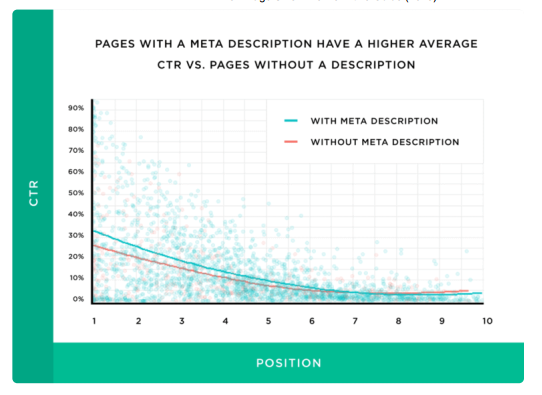
Having a meta description that also includes target keywords is just enough. From my experience, pages with meta descriptions have at least 6% more clicks than the ones without.
Here is a graph to illustrate further the importance of compelling meta descriptions.
If you have not been incorporating meta-descriptions on your website don’t worry. Just do a SEO Website Audit and identify posts and pages that can effectively benefit from meta descriptions and update them.
- Use Question-Based Titles Tags
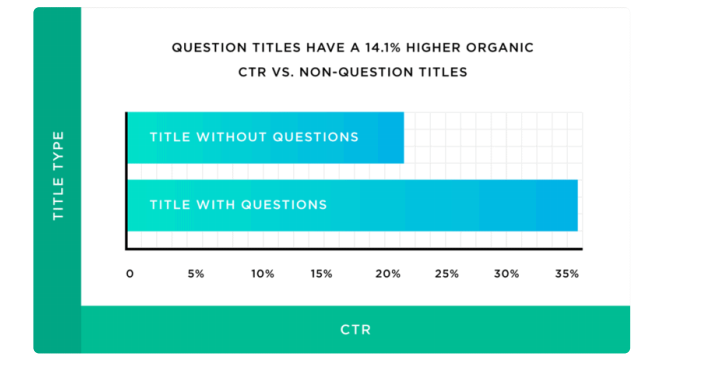
Question-based title tags have a potentially higher organic CTR than the normal titles. A study by Backlinko involving 5 million Google search results found that question-based titles had a 14.1% higher organic CTR than non-question titles.
- Use Creative Emotion-Based Title Tags
Creative emotion-based title tags have a 7% more CTR as compared to normal non-sentimental titles.
However, there are instances whereby emotionally charged words might decrease CTR, especially in situations where such words go overboard to raise suspicions of clickbait.
In such a situation,
Individuals are likely to click another search engine result that appears to be less spammy.
Here’s the deal;
Come up with creative emotion-based titles but avoid spammy terms such as “most insane” and “most powerful.”
- Use Specific Schemas (FAQ/ Review Schema)
Some types of Schemas can be influential on CTR especially when it comes to their association with Rich Snippets
Look;
Rich snippets increase your chances for more clicks.
The two common schemas that are linked to increased CTR comprise;
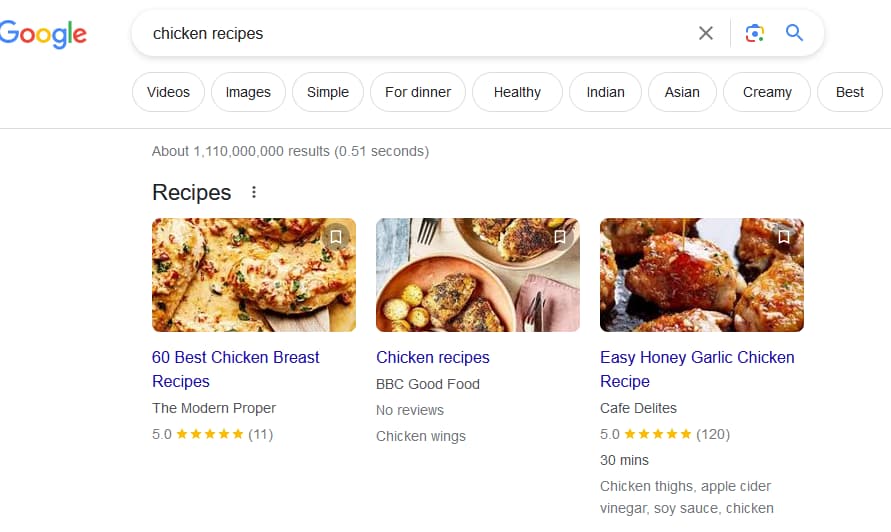
FAQ Schema
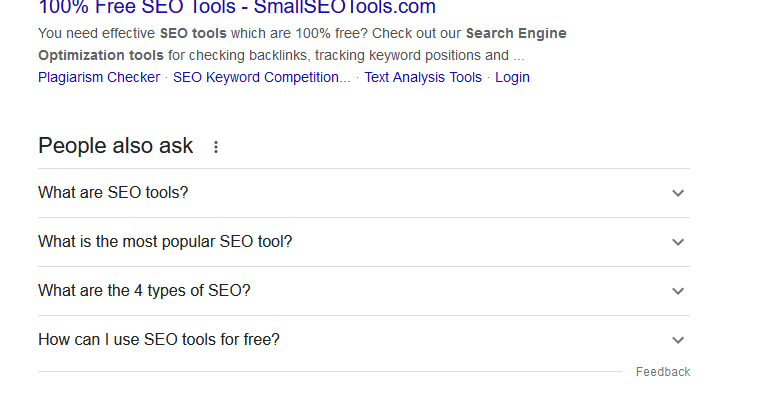
When it comes to setting up the schema’s, remember to use the “Structured Data Testing Tool”
- Include the Current Year in your Title & Description
Including the current year helps especially when it comes to making your title stand out among many other SERPs with content that can be outdated.
However, there are several instances when this technique is not relevant. For instance, in a situation where your content is covering a topic on “American Political History.” In such a case, content that was published even 10 years ago but comprehensively covers the topic is still relevant.
But in the case of a web post with keywords such as “best 75-inch TV’s” then it would be important to include the year since most readers will be thrilled by the most current content.
It is also worth noting that including a year in your title as well as description propagates the needed clarity in terms of how up-to-date is your content.
UX Signals
UX signals form part of the most recommended on-page SEO practices.
Just a quick reminder;
Google monitors closely your website’s bounce rate and dwell time among many other signals.
You should know that Google uses “aggregated and anonymized interaction data” to determine whether search engine results (SERPs) are relevant to user queries.
That being said;
Here are practical UX approaches for maximizing the reader’s Dwell Time.
Use Content Chunks Technique
Chunking your content into smaller portions that comprise of few sentences makes it easier for your readers to skim through the content and identify specific answers to the queries.
The content chunks technique can be achieved by;
- Using more H2 and H3 subheadings
- Using Bullets and numbering
- Using images between pieces of content
Develop An Actively Engaged Community
An active community can be advantageous when it comes to increasing the Dwell Time and reducing the Bounce Rate for specific pages.
Here’s what you should know;
An actively engaged community comes along with a high-quality comment section that attracts readers as soon as they finish skimming or reading your post.
In simple terms, it adds context to your post hence extending the time at which readers will be glued to your page.
Place Content Before the Header Image
Your content should always be configured to suit and exceed user expectations. For instance, when a user clicks your webpage, he/she should easily identify what they want.
For this reason;
- Include a short but comprehensive introduction before any image in the header section.
- Include key takeaways or a summary of what the entire article is all about in the header section of your page.
Here’s a good example of the illustrated approaches.
Chapter Eight: Additional On-Page SEO Practices
Here are some additional practices that will give you an edge when it comes to on-page SEO
Increased Usage of Original Images
Original images have an advantage over stock images.
According to Shai Aharony’s test on the effects of stock images on search engine ranking, websites with unique images tend to outrank others who use stock photos.
Bottomline;
Always try to create custom images for your content.
Image Optimization
Image optimization is not only focused on reducing the size of webpage images but also assigning them descriptive names as well as alt text.
This strategy of optimizing images makes it easier for Google as well as other visually-impaired individuals to understand the image.
Quick Tip: When optimizing images choose one of the images and optimize it around your target keyword/s. For instance, in a case where your target keywords are technical-SEO strategies use the ‘technical-SEO-strategies.jpeg’ when naming your image and also use the same set of keywords ‘technical-SEO-strategies’ as part of the image’s alt-tag.
Use Featured Snippets
Featured snippet-based ranking can contribute significantly to your CTR (Click-Through-Rate) and bring out the difference between you and your competitors
Note: Ensure that your page structure is always consistent with the specific snippet that you’re using.
Use Voice Search SEO Practices
With the increased adoption of AI and accompanying voice-based gadgets such as the Alexa speakers and other devices with built-in chrome cast, optimizing your content for voice search can give you an edge over your competition.
By now you might be wondering;
“How can I optimize my content for voice search?”
Here’s the deal;
Create FAQ sections and pages
Google loves to extract information from the FAQ sections and pages.
Final Thoughts…
In this post, I have discussed all you need to know about on-page SEO practices and also shared a great checklist to help you optimize your web pages. Do you there’s something that I have left out? I will be glad to hear and learn from you in the comment section. Don’t forget to share and sign up for the newsletter for more search engine optimization (SEO) content.